Softer labor market eases Fed angst
Even before the September employment data was released on Friday, downward revisions to the PCE price deflator helped alleviate the sense of urgency for an October Fed hike that had previously permeated the market. After the labor market update, the implied probability of an October hike fell to about 15%, meaning a hike at the next meeting would now be a surprise, rather than the assumed outcome. This aligns our house view that the next Fed hike will only come in December.
Before discussing the specifics of the September employment report, it is worth reiterating a point we’ve made repeatedly in these pages of the past couple of years. The accuracy of US macro statistics is broadly deteriorating as a result of drastically lower response rates, so sizable revisions have become the norm. This complicates the interpretation of the data and makes it unwise to attach too much importance to a single data point. Additionally, as the post-Covid hiring surge vanes and the labor market normalization process concludes, the pace of hiring naturally slows. At those lower levels of hiring, it is then more likely to see the overall performance dip in and out of positive territory. Extracting the correct meaning from these moves becomes even harder given the underlying trend of weak labor force growth, which is both structural (aging population) and cyclically augmented (immigration policy). In a nutshell, it is quite difficult to accurately narrate the labor market story at this time.
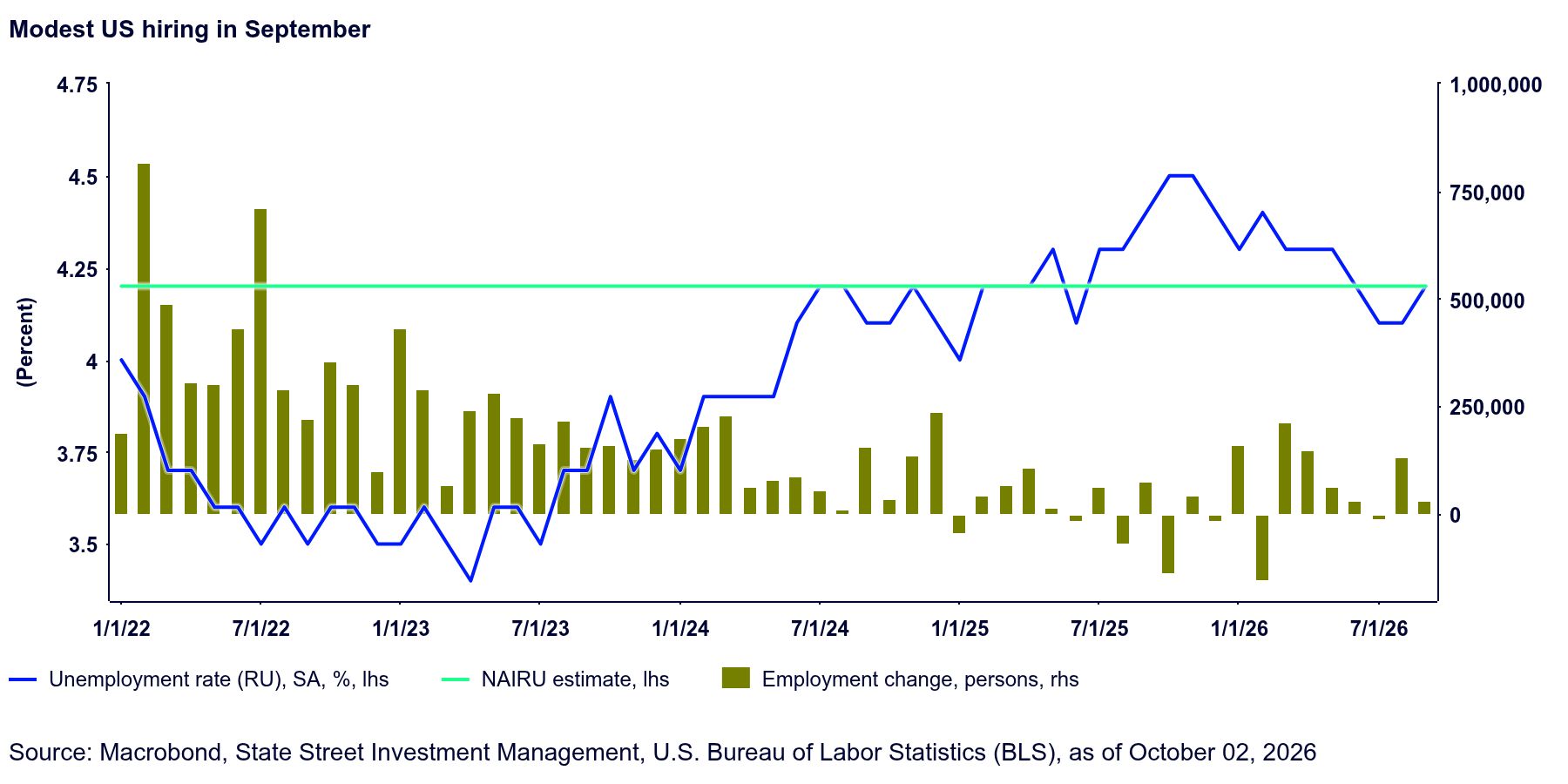
From where we stand, the most important takeaway is that labor demand appears rather subdued overall. Given the constraints on labor force growth, this is not, however, translating into rising unemployment rates. It is, however, translating into very modest wage increases, which in turn suggests that the labor market is not a source of inflationary pressures in a way that should concern the Fed. In these general statements, we have pretty high confidence. In forecasting the month-to-month moves in hiring with accuracy, we do not. But it is the trends that matter.
All these trends were well reflected in the September labor market data. The economy added 29k jobs, but downward revisions to the prior two months actually resulted in a net loss of employment relative to the prior assumed path. Given the magnitude of the headline deceleration, it was not surprising that hiring slowed across the board. The private sector added 46k jobs, half of the August gain, with the good-producing sectors adding 18k (vs. 34k in August) and service sector hiring slowing to 28k (from 55k). Government employment declined by 17k. Within services, job gains were fairly anemic in the segments that added jobs, and there were outright declines in information, financial services, and temporary employment.
The unemployment rate rounded up to 4.2%, which was not bad given that the labor force participation rate inched up two tenths to 61.8%, the highest since May. The average workweek and the aggregate hours index were unchanged. Average hourly earnings rose a very modest 0.1% MoM, lowering the YoY increase by another tenth to 3.0% YoY. The combination of soft hours and wages imply minimal labor income gains for the month. This is a cautionary signal for consumer spending and pricing power in general, although it is important to note that new data have lifted historical estimates of the personal savings rate meaningfully, so this is less of an acute concern than it was before the revision.