No pre-emption needed
Last week we noted that the three dissents in favor of an immediate rate hike all implicitly viewed that hike as a pre-emptive move aimed to avoid larger/faster hikes down the road. This week’s employment update says that no pre-emption is needed. We reiterate our view of a Fed on hold through year-end on the basis of a “do no harm” approach to the labor market and better leading indicators for inflation.
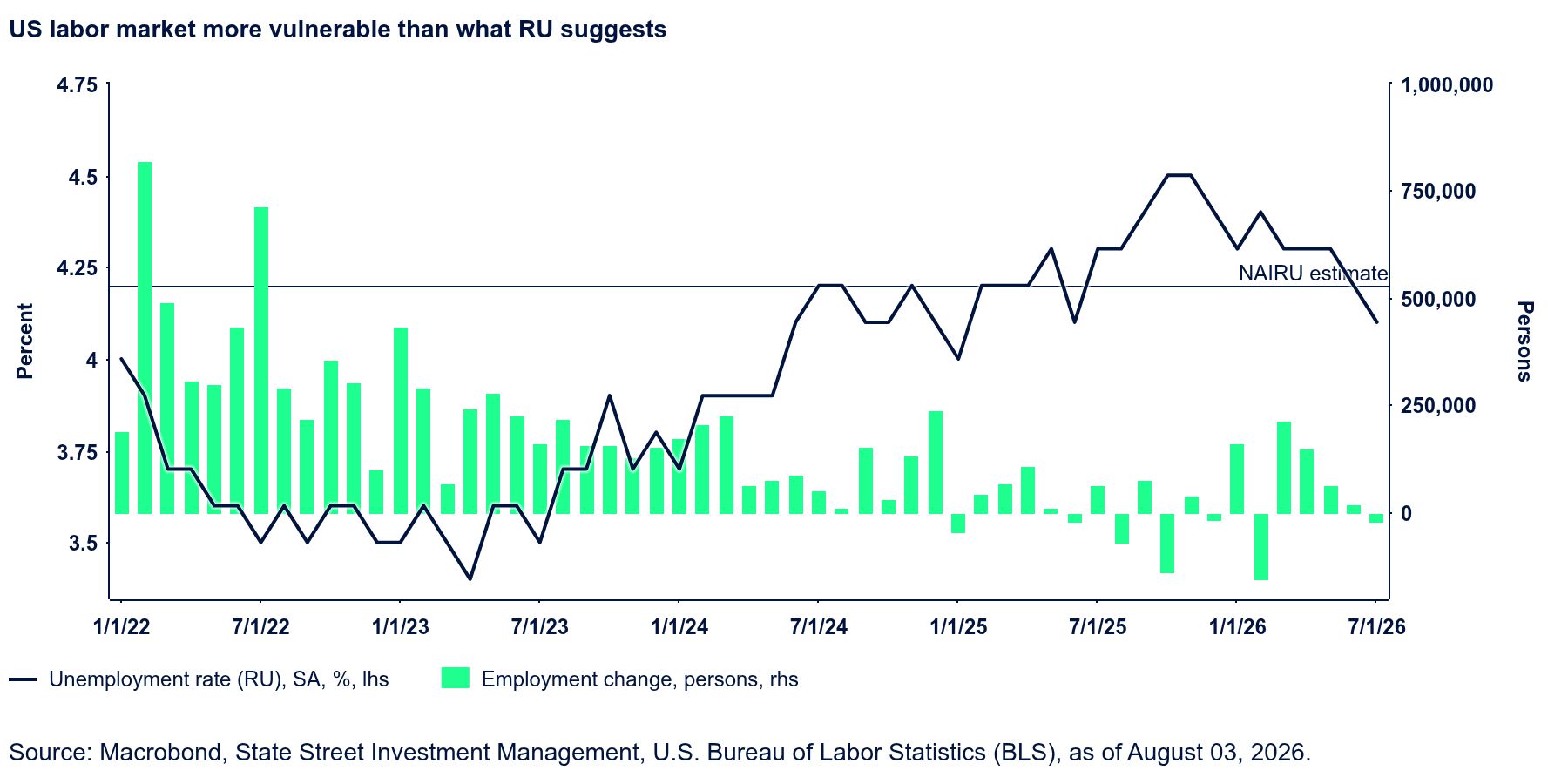
The July employment report was a double-whammy miss. The economy lost 23k jobs (versus the 80k addition expected by Bloomberg consensus) and there was a massive 103k downward revision to the prior two months. The combination dramatically lowered the 3-month average change to just 20k, the lowest since February and a far cry from 142k in May. The weakness was concentrated in private services (only 5k jobs added overall) and in government (-53k). The former likely reflects pullback from earlier World Cup-related hiring, and the latter may reflect some seasonality skews in public education. Both could therefore reverse to some extent, suggesting that the July headline is likely weaker than the true underlying trend in hiring.
Nevertheless, wage inflation retreated further, with AHE (average hourly earnings) inflation easing to 3.2% YoY for both the overall population and for production and non-supervisory employees. Aside from a couple of months during the early days of Covid, these were the mildest increases since right before the pandemic. In conjunction with decent productivity gains, the message is clear: the labor market is NOT a source of inflationary pressures, nor are labor income dynamics supportive of strong second-round inflation effects from the energy shock. There is no need for pre-emptive hikes.
The one data point that could be used to argue for a hike is the one tenth decline in the unemployment rate, now at 4.1% and just below the estimated neutral level. But this decline occurred for undesirable reasons, namely people leaving the labor force, not because unemployment itself declined. Given this, we see payrolls and wage inflation as the more important signal-carrying indicators for the Fed.