US: Strong growth, Fed waits for next move
The Fed’s October meeting was the first “non-event” occurrence in quite a while. As widely expected, the FOMC left the Fed Funds rate unchanged in the 3.75%-4.00% range, though with two somewhat unexpected dissents favoring a hike (Lisa Cook and Beth Hammack). There weren’t any major takeaways from the press conference, but there is every reason to believe that a December hike is more or less a given. It could still be derailed by any number of events (think major risk-off move in markets, Iran re-escalation hitting sentiment, etc.), but on macro data alone, the upcoming “information rich period” is certain to validate its wisdom.
The economy appears able to digest a slight increase in borrowing costs. The FOMC statement described economic activity as expanding “at a strong pace”; third-quarter GDP growth coming in at 3.4% seasonally adjusted annualized (saar) certainly qualifies!
Private consumption growth was steady at 3.8% saar and well-balanced across goods and services. It added 2.5 percentage points (ppts) to growth. This is important because household spending represents 70% of the economy. Recent upward revisions to income bode well for continued strength, although we anticipate some moderation in Q4 following outsized back-to-back gains in the prior quarters.
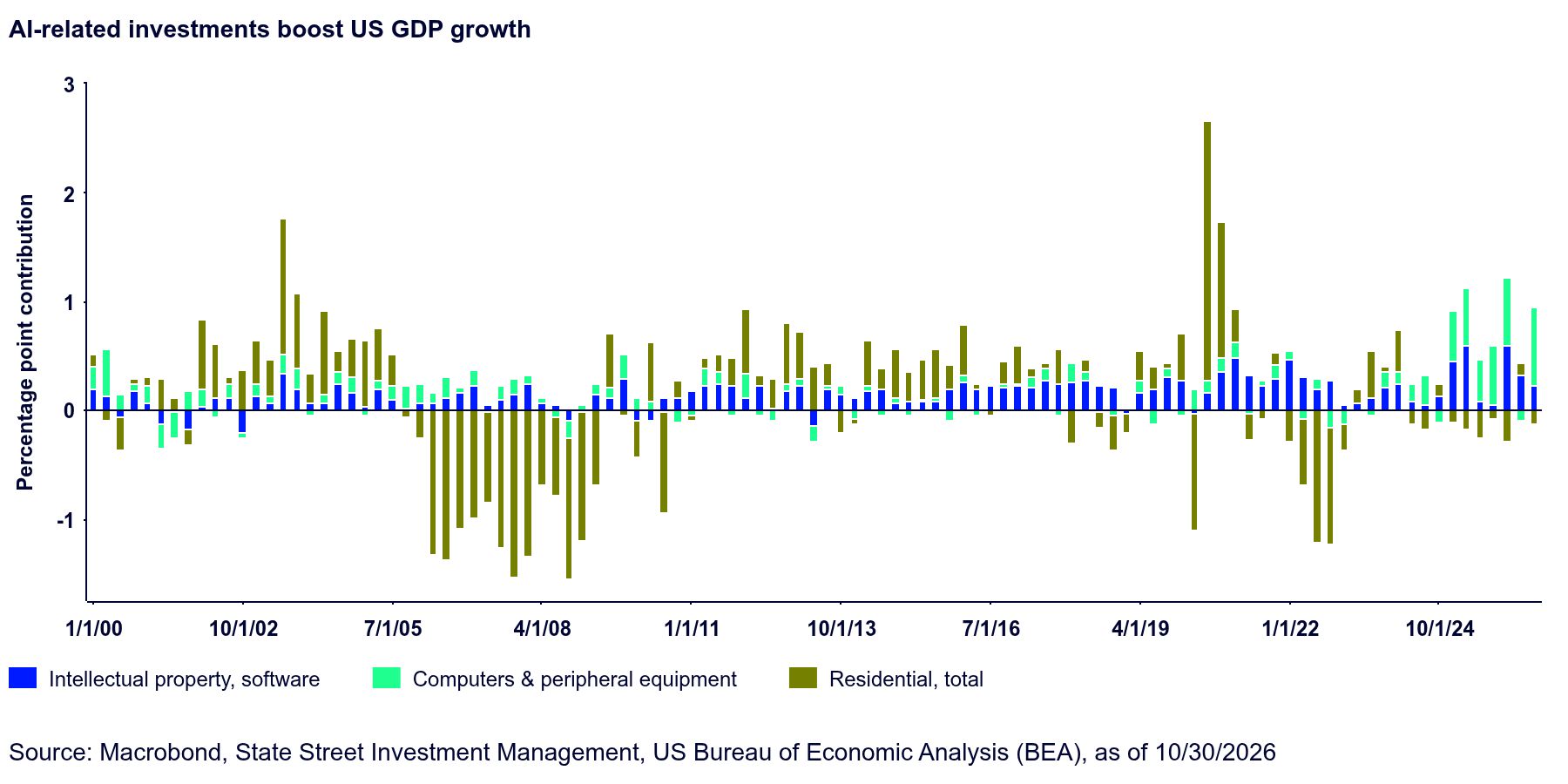
Private investment is surging, although half of the 19.4% saar gain was due to a surprisingly robust buildout in inventories. Of the 9.4% saar growth in private fixed investment, the ultimate standout is computers and peripheral equipment**, which** rose an astounding 66.7% saar! But there was also strength in mining exploration/wells/shafts, and in commercial and healthcare structures, as well as IP products. By contrast, residential construction contracted again. On the whole, private fixed investment added 1.7 ppts to growth and inventories added 1.6. Government demand contributed 0.9 ppt, split roughly even between defense and nondefense, and entirely attributable to the federal government.
Trade was the massive detractor. The combination of lower exports and surging imports (the latter directly driven by AI investments) caused the trade deficit to swell, detracting 3.3 percentage points from quarterly growth. Aside from the tariff-induced spike in the first quarter of 2025, this was the worst performance on record. Presumably, some of the inventory buildout that occurred despite the diminution of oil stocks suggests the impetus of another surge in imports in Q4 may be diminished … but we keep getting surprised here.
During the first three quarters, real GDP grew 2.3% YoY, which is also our full-year target and has been our forecast since last December. A lot is shifting under the surface, but the overall message is one of economic resilience.