Looks like we have work to do
There might not have been many “tier 1” macro data releases this week, but there was a top-tier event: the Fed’s Jackson Hole symposium. It was Chair Warsh’s first opportunity to deliver longer-form remarks since taking the helm at the Fed, and he embraced a clear hawkish tilt.
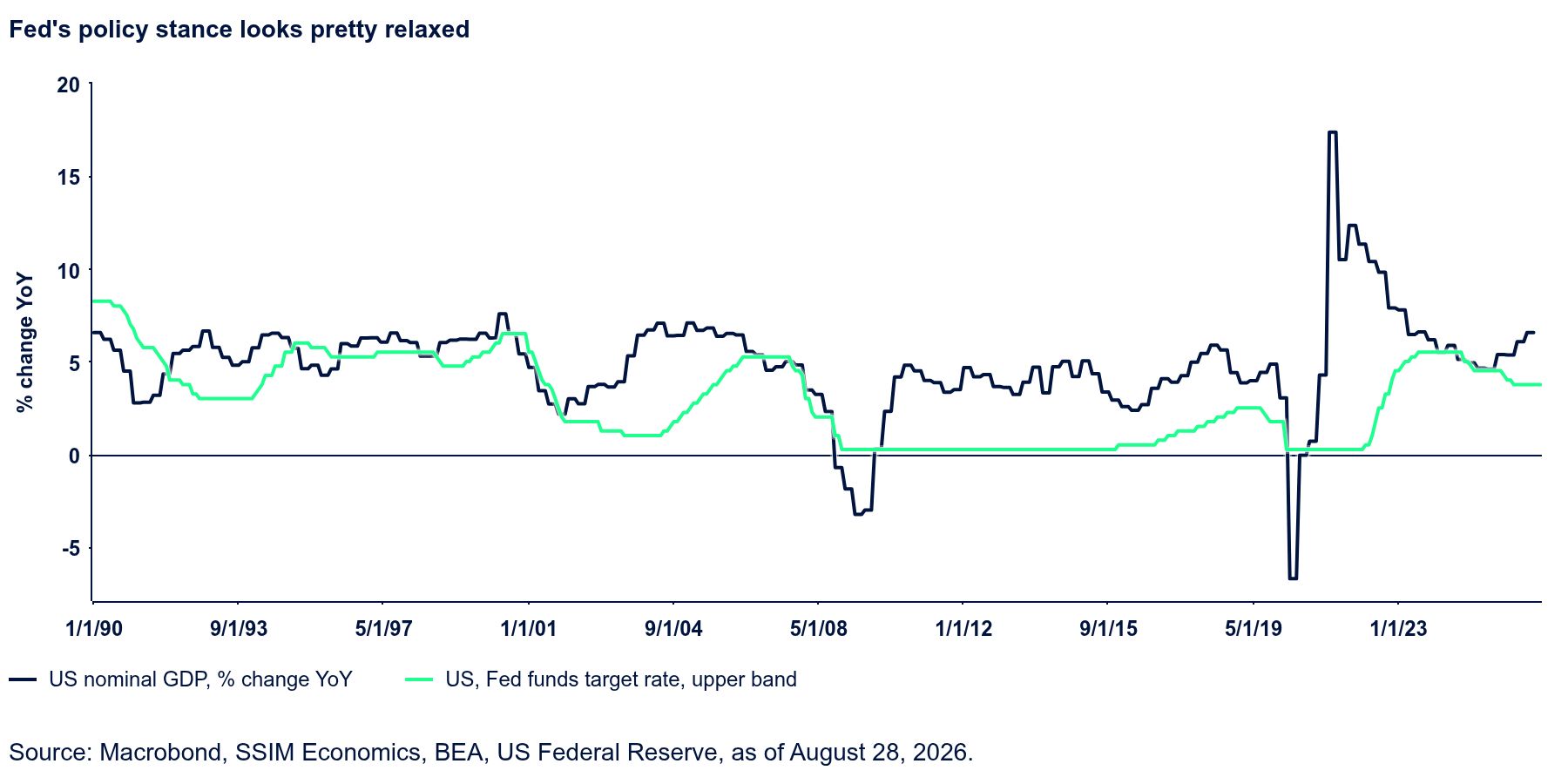
There were several layers to his hawkishness. He reiterated in very clear terms that “the Fed’s price-stability objective of 2 percent, as measured by the PCE index, is a firm, fixed target.” This should not be news to anyone, but it was still important for him to say it. In more practical terms, he stated that “we must be confident that underlying inflation is moving to our objective, clearly and at sufficient speed… otherwise, we have work to do.” This is perhaps the closest he came to providing forward guidance, the reason being that it seems unlikely that those conditions will be met convincingly in the very near term. The conclusion, then, is that the Fed still has “work to do.” Additionally, he downplayed the more encouraging signals, such as tame wage inflation and anchored inflation expectations. He also seemed to dismiss pressures in specific sectors such as housing and emphasized instead the overall economy’s resilient, impressive performance. He would be “hard-pressed” to describe financial conditions as restrictive.
The partial counterweight to this hawkishness was the clear humility he invoked repeatedly in respect to interpreting and responding to the complex, living entity that is the US economy. Questions around data quality and timeliness, the emphasis on trends, the refusals to describe a reaction function, and the acknowledged unknowns around all the big-picture questions surrounding AI softened the otherwise hawkish messaging somewhat.
Nevertheless, the implication is clear: the bias is toward higher rates. Incoming data will need to offer more convincing evidence of improving inflation trends (or labor market deterioration) in order to allow the Fed to remain on hold. The burden of proof is on the doves. We still believe the doves prevail in September (aided by data), but it’s a very close call!