
Monthly Portfolio Statistics
September 30, 2026Market Commentary
The Risk-Free Rate Lost Its Indoor Voice
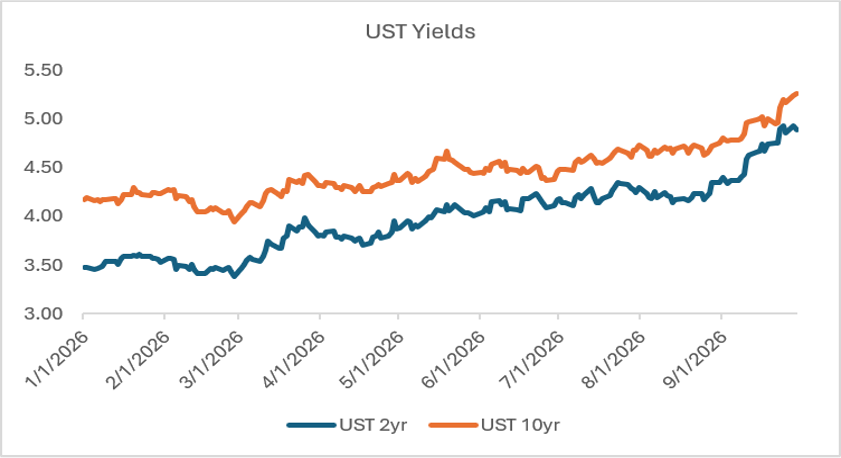
September’s defining story was not simply that Treasury yields rose. It was that they surged while high-quality credit spreads barely moved. The 2-year Treasury climbed 57 basis points to 4.91%, the 10-year jumped 49 basis points to 5.21%, (Figure 1) and the 30-year reached 5.54%. Yet AAA spreads ended exactly where they began, at 27 basis points; AA widened just 2 basis points, A by 4, and BBB by 5. Treasuries pulled the fire alarm. High-grade credit calmly finished its coffee. Lower-quality credit was less relaxed: BB, B and CCC spreads widened 34, 42 and 135 basis points, respectively.
Figure 1: US Treasuries Surged
That disconnect matters. A rates move this violent would ordinarily be expected to drag credit spreads noticeably wider as financial conditions tighten. Instead, the damage remained concentrated primarily in the risk-free curve and lower-quality credit. The most reasonable interpretation—without pretending markets ever provide a single clean answer—is that investors were repricing inflation, monetary policy, real yields, Treasury supply, fiscal sustainability and possibly a higher neutral-rate regime, rather than signaling broad concern about high-quality corporate fundamentals. Strong demand, attractive all-in yields and healthy liquidity likely provided additional technical support. In short, this looked more like a price-of-money shock than a credit-solvency shock.
There was no shortage of fuel. Oil remained around or above $90–$100, September PMIs pointed to resilient growth, and the 10-year Treasury broke above 5% for the first time since 2007. A particularly strong PMI release produced a 16-basis-point one-day move in the 10-year, because apparently bond markets now process economic data with the emotional restraint of a group chat. The selloff also reflected higher real borrowing costs, competition for capital, Treasury issuance and greater compensation for fiscal and term-premium uncertainty—not merely a dramatic unanchoring of long-term inflation expectations.
The Federal Reserve added its own contribution, raising the target range 25 basis points to 3.75%–4.00%, its first hike since 2023. Chair Warsh described the move as removing “a dose of accommodation,” stressed that inflation had been too high for too long and made price stability the Fed’s predominant focus. The updated projections indicated that additional tightening remains possible, with the median participant anticipating another hike before year-end. Warsh nevertheless declined to provide the familiar policy roadmap. The message was essentially: we have a destination, but please stop asking for turn-by-turn directions.
The next move is now the principal uncertainty. Some expect the Fed to skip October and hike in December; others expect another 25-basis-point increase in October; Our Econ Team favors December, and question whether rate increases are the correct tool for an oil-driven supply shock. Inflation breadth, labor-market resilience, energy prices, financial conditions and geopolitical developments will determine which forecast survives contact with reality. Choosing October versus December currently resembles selecting the fastest supermarket checkout line: completely obvious once it is too late to switch.
For money markets, the hike and repricing lifted yields across the complex. SOFR rose to 3.90%, three-month Treasury bills to 4.17%, and three-month Tier-1 commercial paper to 4.07%. Meanwhile, money-market fund assets remained near $7.94 trillion, underscoring the depth of demand for liquidity and income. The environment continues to favor flexibility, disciplined liquidity management and selective maturity extension when compensation improves—without building portfolios around heroic duration forecasts.
September’s lesson was straightforward: credit did not break; the price of time, liquidity and certainty simply reset higher. Cash investors were not innocent bystanders. They were among the few being paid to watch the plot twist.
Liquidity Fund
The CalTRUST Liquidity Fund experienced strong asset growth during September, with AUM increasing from $2.42 billion to $2.66 billion, a 9.8% increase. The fund’s 7-day yield rose 16 basis points to 3.97% month-over-month as short-term rates remained elevated and portfolio positioning benefited from higher floating-rate exposure.
Market participants continued to assess evolving geopolitical developments, incoming economic data, and the financing needs of both the U.S. government and private-sector issuers. Front-end yield curves remained relatively steep as investors weighed the possibility of additional Federal Reserve policy tightening amid resilient economic growth and persistent inflation pressures. Credit spreads widened modestly during the month, although issuer fundamentals remained solid and short-term funding markets continued to function smoothly.
In response to the interest rate environment, the Fund modestly increased its allocation to floating-rate securities, with floating-rate exposure rising from 21.7% to 23.6% of assets, primarily through SOFR-linked investments. Portfolio duration remained conservative, with WAM declining slightly from 43.4 days to 42.7 days, while WAL remained stable at approximately 69 days.
From a sector allocation perspective, exposure to Yankee Certificates of Deposit increased to 27.5% of assets, and Commercial Paper exposure rose to 40.09%. These increases were funded largely through a reduction in repurchase agreements and incoming cash, which declined to 24.6% of the portfolio. ABCP remained the Fund’s largest allocation at approximately 36.0%.
Overall liquidity levels remained exceptionally strong. Weekly liquidity finished the month at 34.9%, while liquidity available within 90 days increased significantly from 64.4% to 70.1% of assets. The Fund continues to maintain a highly liquid, high-quality portfolio designed to preserve capital, meet shareholder liquidity needs, and capture attractive front-end market opportunities.
Key Statistics
| Portfolio | |
|---|---|
| WAM (Weighted Average Maturity) | 44.97 |
| WAL (Weighted Average Life) | 69.13 |
| Distribution Yield (%) | 3.88 |
| 30 Day SEC Yield (%) | 3.87 |
| 7 Day Yield (%) | 3.96 |
| 7 Day Liquidity | 34.88 |
| 90 Day Liquidity | 64.36 |
| Average Credit Quality (S&P) | A-1 |
| Floating Rate Bonds (%) | 21.74 |
Sector Allocation
Historical Performance (Net%)
Short Term Fund
In September 2026, the Short-Term Fund posted a gross total return of 0.03% with income return contributing 0.29% and price return contributing -0.26%.
Income and price return were both large drivers of total return. Treasuries was the largest contributor to income return, returning 0.20%, followed by IG Credit (0.06%), ABS (0.03%), and government related securities (0%).
For price return, Treasuries were the largest contributor at -0.20%, followed by IG credit (-0.05%).
CTST delivered a positive gross return in September despite the sharp rise in Treasury yields as the portfolio’s 0.29% income return absorbed the price impact from higher rates, demonstrating the benefits of attractive carry and short duration positioning in a volatile rate environment.
Key Statistics
| Portfolio | Benchmark | Difference | |
|---|---|---|---|
| Duration (yrs) | 0.73 | 0.53 | 0.20 |
| Distribution Yield (%) | 3.74 | N/A | - |
| 30 Day SEC Yield (%) | 4.23 | N/A | - |
| Yield to Maturity (%) | 4.50 | N/A | - |
| Spread Duration (yrs) | 0.19 | 0.13 | 0.06 |
| OAS (bps) | 5.99 | 12.03 | -6.04 |
| Wal to Worst (yrs) | 0.76 | 0.56 | 0.20 |
| Average Credit Quality (Mdy/S&P) | Aa2/AA | Aa2/AA | - |
| Floating Rate Bonds (%) | 4 | 5 | -1 |
Benchmark: BBG Short Term Govt/Corp Index
Sector Allocation
Monthly Total Return Contribution (Gross bps)
Historical Performance (Net %)
Medium Term Fund
In September 2026, the Medium-Term Fund posted a gross total return of -0.74% with income return contributing 0.35% and price return contributing -1.09%
Price return was the largest driver of total return. Treasuries were the largest contributor at -0.90%, followed by IG credit (-0.15%), ABS (-0.05%), and government-related (-0.01%).
For income return, Treasuries were the largest contributor at 0.24%.
CTMT’s longer duration profile (~2yr) was impacted by September’s ~55bp rise in short-dated US Treasury yields as persistent inflation concerns and the Fed’s rate hike and messaging drove markets to price in tighter monetary policy and financial conditions.
Key Statistics
| Portfolio | Benchmark | Difference | |
|---|---|---|---|
| Duration (yrs) | 2.11 | 1.82 | 0.29 |
| Distribution Yield (%) | 3.97 | N/A | - |
| 30 Day SEC Yield (%) | 4.62 | N/A | - |
| Yield to Maturity (%) | 4.92 | N/A | - |
| Spread Duration (yrs) | 0.46 | 0.45 | 0.01 |
| OAS (bps) | 9.34 | 7.24 | 2.10 |
| Wal to Worst (yrs) | 2.34 | 1.96 | 0.38 |
| Average Credit Quality (Mdy/S&P) | Aa2/AA | Aa2/AA | - |
| Floating Rate Bonds (%) | 4 | 5 | -1 |
Benchmark: ICE BoA Govt/Corp 1-3 yr (ex BBB)